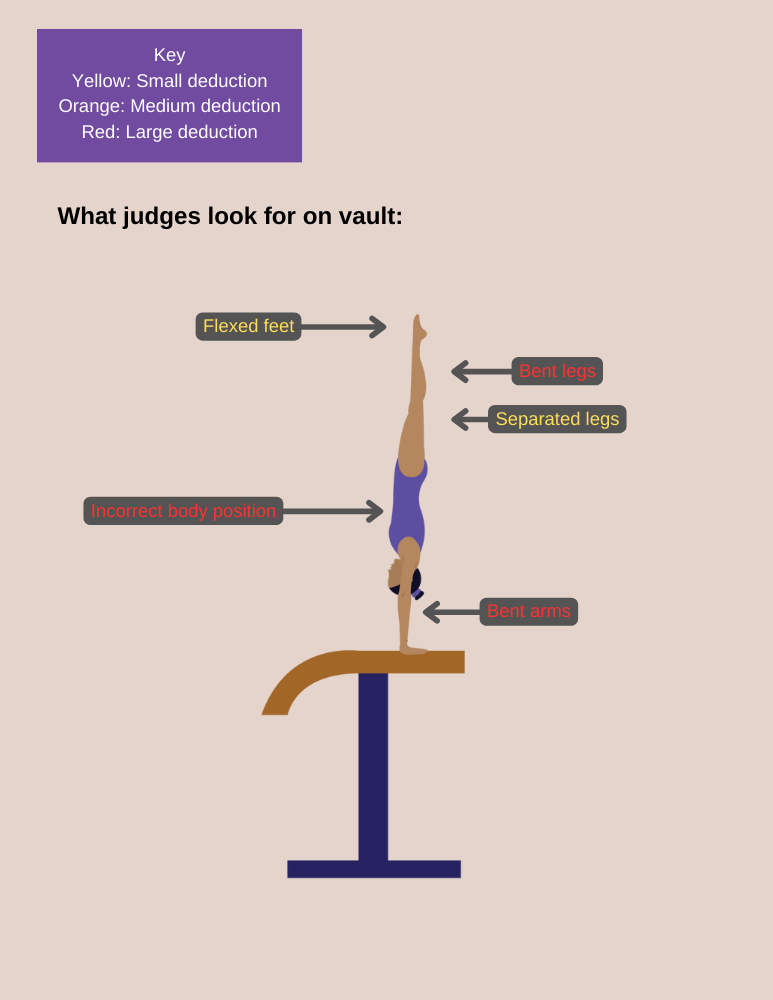
Image Source: gymnasticshq.com
How Do They Score Gymnastics: The Scoring System
How is gymnastics judged? Gymnastics is judged based on a combination of a gymnast’s routine’s difficulty and their flawless execution. Judges award points for successfully performing complex skills (difficulty) and deduct points for errors or imperfections in form, technique, and artistry (execution). The final score is the sum of these two components, minus any deductions.
The world of gymnastics competitions is a dazzling display of athleticism, artistry, and precision. But beneath the polished routines and gravity-defying feats lies a complex and often mystifying scoring system. For those new to the sport, or even seasoned fans, the question of how gymnastics is judged can be a puzzle. This article will delve deep into the intricacies of the gymnastics scoring system, shedding light on the criteria, deductions, and the evolution of how gymnasts earn their medals. We will explore the gymnastics scoring code, the backbone of modern judging, and differentiate between the scoring in artistic gymnastics scoring and rhythmic gymnastics scoring.
The Pillars of Gymnastics Scoring: Difficulty and Execution
At its core, the gymnastics scoring system is built upon two fundamental pillars: the difficulty score gymnastics (often referred to as the D-score) and the execution score gymnastics (or E-score). These two scores are then combined, with deductions applied, to arrive at the gymnast’s final mark for their routine.
The Difficulty Score (D-Score): Building the Foundation
The D-score represents the inherent difficulty of the skills and combinations a gymnast performs. It’s essentially a measure of the “what” – what elements are being attempted. The gymnastics scoring code, governed by the Fédération Internationale de Gymnastique (FIG), dictates the point value assigned to each recognized skill.
Skill Values: A Hierarchy of Hardship
Every skill performed in gymnastics has a predetermined value. These values are assigned based on the complexity, risk, and physical demands of the movement. Generally, skills are categorized from A (the easiest, worth 0.1 points) to J (the most difficult, worth 1.0 points) and beyond in some disciplines.
- A-Skills: Basic movements like a simple forward roll.
- B-Skills: Slightly more complex, like a cartwheel.
- C-Skills: Skills requiring more technique and strength, such as a handstand with a quarter turn.
- D-Skills: More advanced elements, like a kip cast to handstand on uneven bars.
- E-Skills: Skills with significant rotation or complex body positions, like a double pirouette on floor exercise.
- F-Skills: Skills involving multiple twists or flips, such as a double somersault with a twist.
- G-Skills: Highly complex maneuvers requiring great strength and control, like a triple somersault.
- H-Skills: Exceptionally difficult skills, often with multiple flips and twists.
- I-Skills: Elite-level skills, rarely seen and pushing the boundaries of human capability.
- J-Skills: The pinnacle of difficulty, representing the most challenging known skills.
Building the D-Score: Composition and Connection
The D-score is not simply the sum of individual skill values. It is built through a combination of:
- Skill Values: The primary contributors are the values of the most difficult skills performed. The gymnast aims to include as many high-value skills as possible within their routine.
- Connection Values: Performing a series of skills in direct succession can earn bonus points, known as connection values. These bonuses reward fluid transitions and seamless execution between elements. For instance, linking a series of pirouettes on the balance beam might earn extra points if performed correctly.
- Requirements: Each apparatus has specific requirements for the types of skills that must be included. For example, a floor routine might require a tumbling pass with a double somersault and a dismount with a certain number of twists. Failing to meet these requirements results in a deduction from the D-score.
The difficulty score gymnastics is an open-ended system. This means there is theoretically no upper limit to how high a D-score can be. As gymnasts and coaches innovate and develop new, more challenging skills, the potential for higher D-scores increases. This dynamic nature keeps the sport evolving.
The Execution Score (E-Score): Perfection in Practice
The E-score is where the artistry and precision of the gymnast are evaluated. It starts at a perfect 10.0, and judges meticulously deduct points for any imperfections in form, technique, artistry, and presentation. This is where the concept of gymnastics deductions comes into play most prominently.
Common Gymnastics Deductions: The Art of Precision
Judges look for a myriad of small errors that can chip away at the E-score. These include:
- Form Breaks:
- Bent knees or arms when they should be straight.
- Flexed feet or toes not pointed.
- Arched back or rounded shoulders.
- Leg separation during leaps or jumps.
- Execution Errors:
- Hesitation or lack of amplitude in leaps and jumps.
- Journeys or wobbles during balances.
- Steps or hops on landings.
- Lack of height or power in tumbling.
- Body not aligned correctly during skills.
- Artistry and Presentation:
- Lack of rhythm or flow in the routine.
- Poor musicality or connection to the music.
- Expressionless face or lack of engagement.
- Out-of-bounds on floor exercise or beam.
- Falls are a significant deduction.
The Role of the Judges: A Panel of Experts
In major competitions, a panel of judges evaluates each routine. Typically, there is a head judge, a D-score judge (who tallies the difficulty), and multiple E-score judges. The E-score judges observe the routine for execution errors. The highest and lowest E-scores are often dropped, and the remaining scores are averaged to ensure fairness.
The gymnastics scoring criteria are detailed in the FIG Code of Points. This comprehensive document outlines every possible skill, its value, and the specific deductions for various errors. It’s a living document, updated every four years after the Olympic Games, to reflect the sport’s progression.
Putting It All Together: The Final Score
The final score for a gymnast’s routine is calculated as follows:
Final Score = D-Score + E-Score – Penalties
Penalties are separate deductions for infractions that don’t directly relate to the execution of skills, such as exceeding time limits or unsportsmanlike conduct.
Variations in Scoring: Artistic vs. Rhythmic Gymnastics
While the core principles of difficulty and execution apply to both, there are distinct differences in artistic gymnastics scoring and rhythmic gymnastics scoring.
Artistic Gymnastics Scoring
Artistic gymnastics, as seen in the Olympics, encompasses events like floor exercise, vault, uneven bars, and balance beam for women, and floor exercise, pommel horse, rings, vault, parallel bars, and horizontal bar for men.
- Vault: This is a unique event where gymnasts perform one or two vaults. The D-score is based on the specific vault performed (each vault has a set value). The E-score assesses the execution of the vault, including the pre-flight, post-flight, and the landing.
- Bars (Uneven Bars for Women, Parallel Bars & Horizontal Bar for Men): These apparatus require dynamic swings, releases, and regrabs. The D-score is built from the difficulty of the skills, connections, and fulfillment of apparatus-specific requirements. The E-score focuses on clean execution of swings, handstands, releases, and landings.
- Balance Beam (Women): This apparatus demands incredible balance and control. The D-score is derived from the difficulty of acrobatic and gymnastic elements, turns, and leaps, as well as connections. The E-score scrutinizes every movement for wobbles, hesitations, bent knees, and landing precision.
- Floor Exercise (Both Men & Women): This is a combination of tumbling passes, leaps, jumps, and dance elements. The D-score is built from the difficulty of tumbling passes, leaps, and dance elements. The E-score evaluates the execution of all these elements, as well as artistry, choreography, and musicality.
Rhythmic Gymnastics Scoring
Rhythmic gymnastics is a discipline that combines elements of ballet, gymnastics, dance, and apparatus manipulation. The apparatus used are rope, hoop, ball, clubs, and ribbon.
- Apparatus Focus: In rhythmic gymnastics, the routine is performed with one apparatus. The gymnast must demonstrate mastery of the apparatus through throws, catches, balances, and intricate manipulation.
- D-Score Components: The D-score in rhythmic gymnastics is composed of:
- Technical Score: This is based on the difficulty of the body difficulties (leaps, balances, pivots) and apparatus difficulties.
- Artistic Score: This component rewards originality, composition, and expression. Choreography, musicality, and the overall flow of the routine are crucial here.
- E-Score: Similar to artistic gymnastics, the E-score in rhythmic gymnastics starts at 10.0 and deductions are made for errors in execution, manipulation of the apparatus (e.g., dropping the apparatus, poor catches), and body technique.
- Composition and Choreography: A significant aspect of rhythmic gymnastics scoring is the overall composition and choreography. Judges look for creativity, variety of movements, and how well the gymnast integrates the apparatus with their body movements and the music.
- Musicality and Expression: The gymnast’s ability to interpret the music, convey emotion, and engage the audience is also factored into the score.
The gymnastics scoring criteria for rhythmic gymnastics are also meticulously detailed in the FIG Code of Points, with specific requirements for each apparatus and the overall routine.
The Evolution of the Gymnastics Scoring System
The gymnastics scoring system has undergone significant changes over the years. Historically, routines were judged out of a maximum of 10.0 points. This system, while familiar to many, had limitations.
The “Perfect 10” Era
For decades, the “Perfect 10” was the ultimate goal. A gymnast achieving a 10.0 was seen as flawless. However, as the sport evolved and gymnasts began to perform increasingly complex skills, the 10.0 ceiling became restrictive. It was difficult to differentiate between routines with vastly different levels of difficulty when they both might be executed near-perfectly.
The Open-Ended Scoring System
To address these limitations, the FIG introduced an open-ended scoring system. This shift, implemented after the 2004 Athens Olympics, fundamentally changed how gymnasts are scored. The introduction of the separate D-score and E-score allowed for greater differentiation between routines.
- Encouraging Innovation: The open-ended D-score encourages gymnasts and coaches to push the boundaries of skill development and innovation.
- Rewarding Difficulty: Gymnasts who perform more challenging routines are rewarded with higher D-scores.
- Maintaining Precision: The E-score still emphasizes clean execution and artistry, ensuring that difficulty doesn’t come at the expense of fundamental technique.
This new system, outlined in the current gymnastics scoring code, provides a more nuanced and comprehensive evaluation of a gymnast’s performance, reflecting the sport’s continuous progression.
The Judging Process: Precision and Consistency
The process of scoring in gymnastics competitions is a highly structured and disciplined undertaking.
The Role of the Jury
A panel of judges, often referred to as the “jury,” is responsible for scoring. This jury includes:
- Technical Presidents: Oversee the scoring process for a specific apparatus.
- Judges: Evaluate the difficulty and execution.
- Scoring Coordinators: Compile the scores and calculate the final results.
Technological Aids
In modern gymnastics, technology plays a role in ensuring accuracy. Video review systems are sometimes used to clarify specific elements or landings, although the ultimate decision rests with the judges.
Training and Calibration
Judges undergo rigorous training and regular calibration to ensure they are applying the gymnastics scoring criteria consistently. This involves observing routines together and discussing their evaluations to maintain uniformity in their scoring.
Common Misconceptions about Gymnastics Scoring
- “A fall is always a full point deduction.” While a fall is a significant deduction (typically 1.0 point for artistic gymnastics), the exact deduction can vary slightly based on the apparatus and specific circumstances as outlined in the gymnastics scoring code.
- “The score is just out of 10.” This is no longer true with the open-ended scoring system. The final score is the sum of the D and E scores, which can often exceed 10.0.
- “Judges are biased.” While judging can be subjective to a degree, the extensive training, clear criteria in the gymnastics scoring code, and multiple judges help to minimize bias. The open-ended system, with its objective D-score, also helps to remove some of the subjectivity.
Conclusion
The gymnastics scoring system is a complex yet fascinating mechanism that aims to objectively measure a gymnast’s athleticism, skill, and artistry. By combining a difficulty score gymnastics that rewards challenging skills with an execution score gymnastics that penalizes imperfections, the system provides a comprehensive evaluation. From the precise movements in artistic gymnastics to the fluid routines in rhythmic gymnastics, the dedication to detail in how gymnastics is judged ensures that the sport continues to evolve and inspire. The meticulous application of the gymnastics scoring criteria within the gymnastics scoring code is what allows us to celebrate the extraordinary achievements of these remarkable athletes.
Frequently Asked Questions (FAQ)
Q1: What is the maximum score a gymnast can achieve?
A1: In the current open-ended scoring system, there is no theoretical maximum score. The score is the sum of the Difficulty Score (D-Score) and the Execution Score (E-Score). The D-Score can increase as gymnasts perform more difficult skills and combinations.
Q2: Can I score gymnastics at home?
A2: While you can learn the general principles of gymnastics scoring, accurately scoring a routine at home without extensive training and the official gymnastics scoring code is very difficult. Judges are highly trained professionals who apply very specific criteria.
Q3: Who creates the gymnastics scoring code?
A3: The gymnastics scoring code is created and updated by the Fédération Internationale de Gymnastique (FIG), the international governing body for gymnastics. It is typically revised every four years after the Olympic Games.
Q4: How are connection bonuses awarded?
A4: Connection bonuses are awarded for performing specific, difficult skills in direct succession without pauses or preparatory movements. The exact bonus points are detailed in the gymnastics scoring code and depend on the difficulty of the connected skills.
Q5: What is the difference between a skill deduction and a penalty?
A5: Skill deductions are taken from the Execution Score (E-Score) for errors in form, technique, or execution of a specific element. Penalties are separate deductions taken from the total score for rule violations such as exceeding time limits, stepping out of bounds, or unsportsmanlike conduct.
Q6: How does the scoring for different apparatus differ in artistic gymnastics?
A6: While the core D-score and E-score principle remains, the specific skills, requirements, and potential deductions vary significantly between apparatus like the vault, uneven bars, balance beam, and floor exercise, all governed by the gymnastics scoring code.