A knee sprain happens when you stretch or tear the tough bands called ligaments that connect your knee bones. People often ask, “How long after a knee sprain can I exercise?” You can usually start gentle movement very soon, maybe even the next day, but safely returning to regular exercise and sports takes much longer. The exact time depends a lot on how bad your sprain is and how your body heals. It could be anywhere from a few weeks for a mild sprain to many months for a serious tear.
Image Source: my.clevelandclinic.org
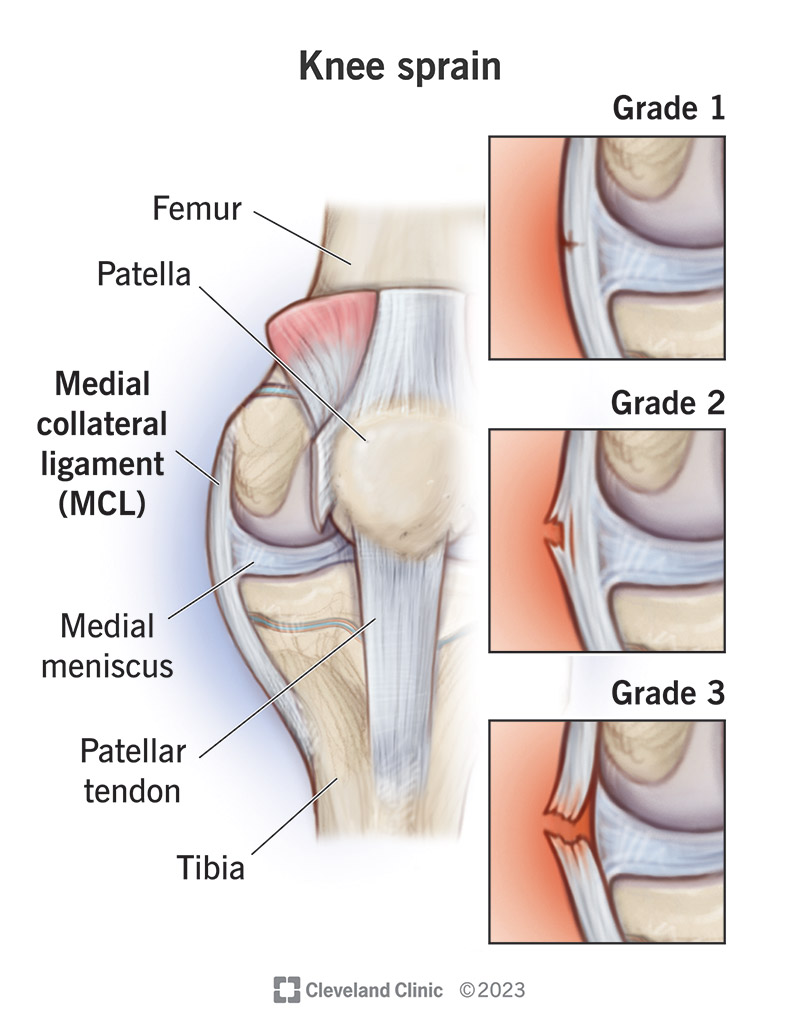
Learning About Knee Sprains
Your knee joint is kept stable by four main ligaments:
- ACL (Anterior Cruciate Ligament): In the middle of the knee, stops the shinbone from sliding forward too much.
- PCL (Posterior Cruciate Ligament): In the middle of the knee, stops the shinbone from sliding backward too much.
- MCL (Medial Collateral Ligament): On the inside of the knee, stops the knee from bending inward.
- LCL (Lateral Collateral Ligament): On the outside of the knee, stops the knee from bending outward.
A sprain is a stretch or tear of one of these ligaments. Ligaments are like strong ropes. When they get injured, it can make your knee feel wobbly or unstable.
Grading a Knee Sprain
Doctors put knee sprains into different levels based on how bad the injury is. This grade helps figure out how long the healing process for knee sprain might take and when you can think about returning to activity after knee sprain.
Grade 1 Sprain
- What it is: The ligament is stretched but not torn. It might have very small tears that you can’t easily see.
- How it feels: Mild pain, maybe some swelling, the knee feels stable.
- Recovery: Often the fastest recovery time.
Grade 2 Sprain
- What it is: The ligament is partly torn.
- How it feels: More pain, more swelling, the knee might feel a bit loose or unstable when you try to use it. It hurts to put weight on it.
- Recovery: Takes longer than a Grade 1.
Grade 3 Sprain
- What it is: The ligament is completely torn into two pieces.
- How it feels: Severe pain right away, a lot of swelling, the knee feels very unstable, or you can’t use it at all. Sometimes the pain gets better quickly because the nerve fibers are also torn.
- Recovery: This is the most serious. It often needs surgery and takes the longest to heal.
Knowing the grade of your sprain is the first step to understanding your knee sprain recovery time. A doctor or physical therapist can tell you the grade after they check your knee.
The Healing Process for Knee Sprain
Healing is a natural process, but it takes time. Your body goes through steps to fix the injured ligament. It’s important to respect these steps. Trying to do too much too soon can mess up the healing and make things take longer or even cause more injury.
Step 1: Inflammation (First few days)
- What happens: Right after the sprain, your body sends blood and fluid to the injured spot. This causes swelling, pain, and warmth. This is the body’s way of starting the repair work and protecting the area.
- What you should do: Focus on rest, ice, compression, and elevation (RICE). Avoid putting weight on the knee if it hurts badly.
Step 2: Repair (Several days to a few weeks)
- What happens: Your body starts laying down new tissue (collagen) to fix the torn ligament fibers. This new tissue is weak at first.
- What you should do: Start gentle movement and light exercises as your doctor or therapist tells you. The goal is to get some motion back without hurting the new tissue. Physical therapy exercises for knee sprain begin here. Pain level before exercising knee sprain is a big guide; you should only do movements that cause little or no pain.
Step 3: Remodeling (Several weeks to many months)
- What happens: The new tissue gets stronger and starts to organize itself like the original ligament. This is a slow process. The tissue becomes more like a strong rope again.
- What you should do: Gradually increase exercise difficulty and add more weight or resistance. This helps the ligament tissue get stronger. You work on balance, strength, and getting your full movement back. Returning to activity after knee sprain happens during this step, slowly increasing what you do.
Knee Sprain Recovery Time: What Affects It?
There’s no exact calendar for everyone. Several things change how fast your knee heals:
- The Grade of the Sprain: A Grade 1 heals faster than a Grade 2, and a Grade 3 takes the longest, especially if surgery is needed.
- Which Ligament is Hurt: Some ligaments heal better on their own than others. For example, MCL sprains often heal well without surgery, while complete ACL tears usually need surgery for people who want to return to sports after knee sprained ligament.
- Your Age: Younger, healthier people often heal faster than older people.
- Your General Health: Do you have other health problems? Do you smoke? These can affect healing.
- How Well You Follow Instructions: Doing too much too soon, or not doing your exercises, can make recovery take longer.
- Getting the Right Care: Seeing a doctor and physical therapist early helps guide your recovery properly.
- Other Injuries: If you hurt other parts of your knee or leg at the same time, recovery will take longer.
- Your Activity Goals: If you want to run marathons or play soccer, you need more strength and stability than someone who just wants to walk comfortably.
It’s safe to say that for a simple Grade 1 sprain, you might feel mostly better in 2-4 weeks. For a Grade 2, it could be 6-12 weeks or more. For a Grade 3, especially with surgery, it can take 6 months to a year or even longer to feel fully recovered and ready for intense activities.
When Can I Walk on a Sprained Knee?
This is a common question. You might be able to walk on a sprained knee fairly soon, but it depends on the sprain’s grade and your pain level.
- Grade 1: You might be able to walk with a little limp almost right away. Pain will be the main guide. If it hurts a lot, don’t push it.
- Grade 2: Walking will likely be painful and difficult at first. You will probably need crutches for a few days or weeks to take weight off the knee. You can gradually start putting more weight on it as the pain goes down and your strength improves.
- Grade 3: You will almost certainly need crutches and may need a brace to keep the knee stable. Putting full weight on it might not be possible for several weeks or even months, especially if surgery is planned.
Even when you can walk, it might not be normal walking for a while. A limp is common. The goal is to walk as normally as possible without pain before trying other exercises. Your doctor or physical therapist will tell you when it’s safe to start putting weight on the knee and walking more.
Returning to Activity After Knee Sprain: Taking Steps
You can’t just jump back into your old routine. Returning to activity needs to happen in steps. Each step builds on the one before it.
Step 1: Rest and Protect (First few days)
- Goal: Stop more injury, reduce pain and swelling.
- What to do: RICE (Rest, Ice, Compression, Elevation). Maybe use crutches or a brace. Avoid putting weight on the leg if it hurts.
- Exercise: Very gentle movements, like wiggling your toes or tightening your thigh muscle (quad set). Only if they don’t cause significant pain.
Step 2: Gentle Movement and Basic Strength (Starts when swelling decreases and pain lessens)
- Goal: Get back your knee’s ability to move fully, start basic muscle strength around the knee.
- What to do: Start specific physical therapy exercises for knee sprain.
- Exercise:
- Ankle pumps (moves blood, helps swelling).
- Quad sets (tightening your thigh muscle while your leg is straight).
- Hamstring sets (pressing your heel down while your leg is straight).
- Gentle knee bends and straightening while sitting or lying down (Range of Motion exercises).
- Straight leg raises (lifting your straight leg while lying down).
- As pain allows, walking with crutches, then gradually putting more weight on the leg.
- Key: Pain level before exercising knee sprain is crucial. If an exercise makes pain much worse, stop or do it more gently. Some mild discomfort is okay, but sharp or increasing pain is a warning sign. Swelling after knee sprain exercise that gets worse is also a sign you did too much.
Step 3: Build Strength and Balance (Starts when you can walk reasonably well with little pain)
- Goal: Make the muscles around the knee stronger, improve balance, prepare for more active movements.
- What to do: Continue and advance physical therapy exercises for knee sprain.
- Exercise:
- Mini squats (bending knees just a little).
- Calf raises (standing on tip-toes).
- Step-ups (stepping onto a low box).
- Leg press machine (with light weight).
- Hamstring curls machine.
- Balance exercises (standing on one leg).
- Walking for longer periods or slightly faster.
- Key: Progress slowly. Listen to your body. No sharp pain. Swelling after knee sprain exercise should not increase significantly or should go down quickly with ice.
Step 4: Prepare for Specific Activities (Starts when strength is good and movement is normal)
- Goal: Get your knee ready for the specific things you want to do, like running, jumping, or sports moves.
- What to do: Do exercises that copy the movements needed for your activity or sport. This is key for return to sports after knee sprained ligament.
- Exercise:
- Lunges.
- Squats (deeper).
- Controlled hopping or jumping (start with two legs, then one).
- Side-to-side movements.
- Gentle jogging (start short distances).
- Agility drills (like cone drills).
- Key: This step is often guided closely by a physical therapist. They will check if your knee is strong and stable enough for these harder movements. Avoiding re-injury after knee sprain is very important here.
Step 5: Gradual Return to Full Activity (Starts when you pass tests and feel ready)
- Goal: Slowly go back to your sport or full exercise routine.
- What to do: Start with limited participation (e.g., practice but not games, shorter exercise sessions).
- Exercise: Begin doing your sport’s specific drills. Gradually increase time and intensity in games or activities.
- Key: Continue any necessary strengthening or balance exercises. Wear a brace if recommended. Stop if pain or swelling returns. This is the final stage of return to sports after knee sprained ligament.
Safe Exercises After Knee Sprain: Examples
Here are some examples of safe exercises you might do, depending on which step of recovery you are in. Always check with your doctor or physical therapist before starting any exercise.
Early Stage (When you have pain and swelling)
- Ankle Pumps:
- Lie down.
- Move your foot up and down slowly, like pushing a gas pedal.
- Do this 10-20 times every hour.
- Quad Sets:
- Lie on your back with your leg straight.
- Push the back of your knee down into the bed or floor. You should feel the muscle on top of your thigh tighten.
- Hold for 5-10 seconds.
- Repeat 10-15 times.
- Hamstring Sets:
- Lie on your back with your leg straight.
- Try to pull your heel towards your buttock without bending the knee. You should feel the muscle on the back of your thigh tighten.
- Hold for 5-10 seconds.
- Repeat 10-15 times.
- Gentle Knee Bends (Sitting):
- Sit in a chair.
- Let your injured leg hang down.
- Gently let your knee bend as far as it comfortably goes using gravity.
- Straighten it using the muscles in your thigh.
- Repeat slowly 10-15 times.
Middle Stage (When pain and swelling are mostly gone, getting stronger)
- Straight Leg Raises (Lying):
- Lie on your back. Keep the injured leg straight.
- Lift the straight leg up about a foot off the floor. Keep your thigh muscle tight.
- Lower it slowly.
- Repeat 10-15 times. Can do side and back lifts too.
- Mini Squats:
- Stand with your feet shoulder-width apart, holding onto a counter or chair for balance.
- Bend your knees slightly, as if sitting back into a chair just a little bit (10-20 degrees). Keep your back straight.
- Stand back up slowly.
- Repeat 10-15 times.
- Calf Raises:
- Stand holding onto something for balance.
- Raise up onto the balls of your feet.
- Lower slowly.
- Repeat 10-15 times.
- Step-Ups:
- Stand facing a low step (like the bottom stair).
- Step up onto the step with your good leg, then bring your injured leg up.
- Step down leading with your good leg.
- As you get stronger, lead with the injured leg.
- Repeat 10-15 times on each leg.
- Balance Exercises (Single Leg Stand):
- Stand near a wall or counter for support.
- Lift your good leg off the floor, balancing on the injured leg.
- Try to hold for 10-30 seconds.
- As it gets easier, try closing your eyes.
Later Stage (Getting ready for full activity or sports)
- Fuller Squats:
- Stand with feet shoulder-width.
- Squat down as if sitting in a chair, aiming for knees to bend to 90 degrees or more if comfortable. Keep back straight.
- Stand up slowly.
- Repeat 10-15 times. Can add weights later.
- Lunges:
- Stand tall.
- Step forward with one leg, bending both knees to about 90 degrees. Keep front knee over ankle.
- Push off with the front foot to return to standing.
- Repeat 10-15 times on each leg.
- Lateral Squats/Lunges:
- Step sideways, bending the knee of the stepping leg while keeping the other leg straight.
- Push off to return to center.
- Repeat 10-15 times on each side.
- Introduction to Jumping/Hopping:
- Start with two-leg hops in place.
- Progress to two-leg hops forward/backward/side-to-side.
- Move to single-leg hops on the injured leg (only when very strong and stable).
- Light Jogging:
- Start with short bursts (e.g., 1 minute jogging, 2 minutes walking).
- Gradually increase jogging time and decrease walking time.
- Only progress if there is no pain or swelling increase.
These are just examples. Your physical therapist will create a specific plan for you based on your injury and goals.
Monitoring Your Body: Pain and Swelling
Paying close attention to your body is key during recovery. Pain and swelling are important signals.
- Pain level before exercising knee sprain: Before you start any exercise, note your pain level. Maybe on a scale of 0 (no pain) to 10 (worst pain).
- During Exercise: You might feel some discomfort or fatigue in the muscles working. This is often okay. Sharp pain, sudden pain, or pain that rapidly gets worse is a sign to stop that exercise or activity. Your pain level should generally stay low (maybe 0-3 out of 10) during early and middle-stage exercises.
- After Exercise: How does your knee feel 30 minutes after exercising? How about the next morning?
- Good Sign: Pain is the same or only slightly increased and goes away quickly (within an hour or two). Swelling does not increase significantly.
- Bad Sign: Pain is much worse after exercising and lasts for hours or days. Swelling after knee sprain exercise is much worse or doesn’t go down with rest and ice. This means you likely did too much.
Use pain and swelling as a guide. It’s better to do a little less than too much. Pushing through significant pain can re-injure the ligament or make healing take much longer.
Avoiding Re-Injury After Knee Sprain
Getting back to activity is exciting, but avoiding re-injury after knee sprain is critical. You don’t want to go through the recovery process again.
Here are ways to lower your risk:
- Don’t Rush: This is the most important thing. Follow your recovery plan. Don’t try to skip steps.
- Complete Your Rehab: Finish your physical therapy program, even if your knee feels better. Therapists work on strength, balance, and movements that are vital for long-term stability.
- Maintain Strength and Flexibility: Even after you return to activity, keep doing some strengthening and stretching exercises for your knee and leg. Strong muscles support the joint.
- Warm Up Properly: Before any exercise or sport, spend 5-10 minutes doing light activity (like walking or gentle cycling) and dynamic stretches (like leg swings). This gets your muscles ready.
- Cool Down and Stretch: After activity, gentle static stretches (holding a stretch) can help.
- Use Proper Technique: If you play a sport, make sure your movements (like landing from a jump or changing direction) are correct to put less stress on your knee.
- Listen to Your Body (Still!): Even when back to full activity, pay attention. If your knee aches more than usual, feels unstable, or swells, take a break, ice it, and maybe reduce your activity level for a bit.
- Consider a Brace: For some ligament injuries, especially when returning to sports, a brace might be recommended by your doctor to provide extra support. Discuss this option.
- Surface Awareness: Be careful on uneven or slippery surfaces.
- Don’t Ignore Pain: Persistent pain means something is wrong. See your doctor or therapist.
Return to Sports After Knee Sprained Ligament
Returning to sports is the final goal for many people. It requires the knee to be very strong, stable, and able to handle the demands of the sport.
Here are general signs you might be ready (again, guided by a professional):
- No Pain: You can do daily activities and specific sport movements without pain.
- Full Range of Motion: Your injured knee can bend and straighten as much as your uninjured knee.
- Good Strength: The muscles around your injured knee are nearly as strong (within 85-90%) as the muscles around your uninjured knee. Strength tests are often done to check this.
- Good Balance and Proprioception: You can balance well on the injured leg and know where your leg is in space without looking.
- Ability to Perform Sport-Specific Movements: You can run, cut, jump, and land smoothly and without pain or fear.
- Psychological Readiness: You feel confident and ready to play without worrying too much about your knee.
The process usually involves starting with practice drills that don’t involve contact or sudden changes of direction, then slowly adding more complex movements and eventually returning to games or full competition. This might take several months after you finish basic rehab, especially for higher-grade sprains or surgical recovery.
Why Professional Help Matters
Dealing with a knee sprain on your own is risky. A doctor can properly diagnose the injury, figure out the grade, and rule out other problems like broken bones.
A physical therapist is crucial for guiding your recovery. They can:
- Create a personalized exercise plan based on your specific sprain and goals.
- Show you how to do exercises correctly.
- Help you manage pain and swelling.
- Tell you when it’s safe to move to the next step in your recovery.
- Assess your strength, balance, and movement patterns to ensure you are ready for different activities and sports.
- Help you learn how to avoid re-injury after knee sprain.
Trying to guess when and how to exercise can lead to doing too little (slowing recovery) or too much (causing more injury). Working with professionals gives you the best chance for a full and safe recovery.
Table Summary: General Timelines (Approximate)
This table gives rough ideas. Your actual time might be different.
| Stage/Activity | Grade 1 Sprain | Grade 2 Sprain | Grade 3 Sprain (Non-Surgical) | Grade 3 Sprain (Surgical) |
|---|---|---|---|---|
| Initial Rest/Protection | 1-3 days | 3-7 days | 1-3 weeks | 1-4 weeks |
| Start Gentle Movement/PT | 1-3 days | 3-7 days | 1-3 weeks | 2-6 weeks |
| Walk without Crutches | Days to 1 week | 1-4 weeks | 4-8 weeks or more | 6-12 weeks or more |
| Basic Strength Exercises | Starts week 1 | Starts weeks 1-2 | Starts weeks 4-8 | Starts weeks 6-12 |
| Prepare for Activity (Running/Jumping) | Weeks 2-4 | Weeks 4-8 | Months 2-4 | Months 3-6 |
| Return to Full Exercise/Sport | Weeks 3-6 | Weeks 6-12 (or more) | Months 4-6 (or more) | Months 6-12+ |
Note: Surgical recovery times can vary greatly based on the type of surgery and individual factors.
Wrapping Up
Knowing how long after a knee sprain you can exercise safely isn’t a simple answer measured in exact days or weeks. It’s a process guided by how well your knee is healing, the type and severity of your sprain, and your body’s signals like pain and swelling.
Starting with rest, moving to gentle physical therapy exercises for knee sprain, building strength and balance, and finally easing back into more demanding activities or return to sports after knee sprained ligament are all key steps. Always pay attention to your pain level before exercising knee sprain, stop if you have sharp pain, and notice if swelling after knee sprain exercise gets worse.
Getting help from a doctor and a physical therapist is the best way to make sure you follow a safe path to recovery and are successful in avoiding re-injury after knee sprain. Be patient with your body. Healing takes time, but safe, gradual exercise is essential to getting your knee strong and stable again.
Frequently Asked Questions (FAQ)
Is it okay if my knee still feels a little stiff?
A little stiffness, especially in the morning or after sitting, can be normal for a while during the healing process for knee sprain. Regular gentle movement and stretching can help. However, if stiffness is severe or doesn’t improve, talk to your therapist or doctor.
Can I run after a Grade 1 knee sprain?
For a Grade 1 sprain, you might be able to start a walk-to-jog program within 3-6 weeks, if you have no pain with walking, good strength, and full movement. Don’t start running until a professional says you are ready.
What should I do if my knee swells up after exercising?
If you notice swelling after knee sprain exercise, it’s usually a sign you did too much. Stop the activity that caused it. Go back to RICE (Rest, Ice, Compression, Elevation). Reduce the intensity or duration of your exercises for the next day or two. If swelling is severe or doesn’t go down, contact your physical therapist or doctor.
How do I know if I’m pushing too hard?
Signs you’re pushing too hard include:
* Sharp or sudden increase in pain during exercise.
* Significant increase in pain that lasts for hours or days after exercise.
* Increased swelling after knee sprain exercise that wasn’t there before or gets worse.
* Limping or difficulty walking the day after exercise.
Do I need surgery for a knee sprain?
Grade 1 and most Grade 2 sprains of the MCL and LCL usually heal without surgery. A complete tear (Grade 3) of the ACL often requires surgery, especially for active people who want to return to sports after knee sprained ligament. Complete tears of the PCL or Grade 3 MCL/LCL sprains may or may not need surgery depending on other factors. Your doctor will tell you if surgery is needed.
How long does physical therapy take for a knee sprain?
The length of physical therapy depends on the sprain grade and your progress. For a Grade 1, it might be 2-4 weeks. For a Grade 2, it could be 6-12 weeks. For a Grade 3 (especially with surgery), it can last 6-12 months or even longer as you work through all stages, including return to sports.