So, how long does it take for Kegel exercises to work? Generally, you can expect to start noticing positive changes within 4 to 6 weeks of consistent practice, with more significant improvements often appearing between 8 to 12 weeks.
Kegel exercises are a powerful tool for strengthening your pelvic floor muscles. These muscles play a vital role in bladder control, bowel control, and sexual function for both men and women. Many people wonder about the kegel results timeline, and the answer is that it’s not an instant fix. Like any form of strength training, kegel exercise effectiveness depends on dedication and proper technique. This in-depth guide will explore the kegel improvement duration, delve into how to optimize your kegel exercise routine, and explain when to expect kegel benefits. We’ll cover everything you need to know to be successful with your kegel training progress.
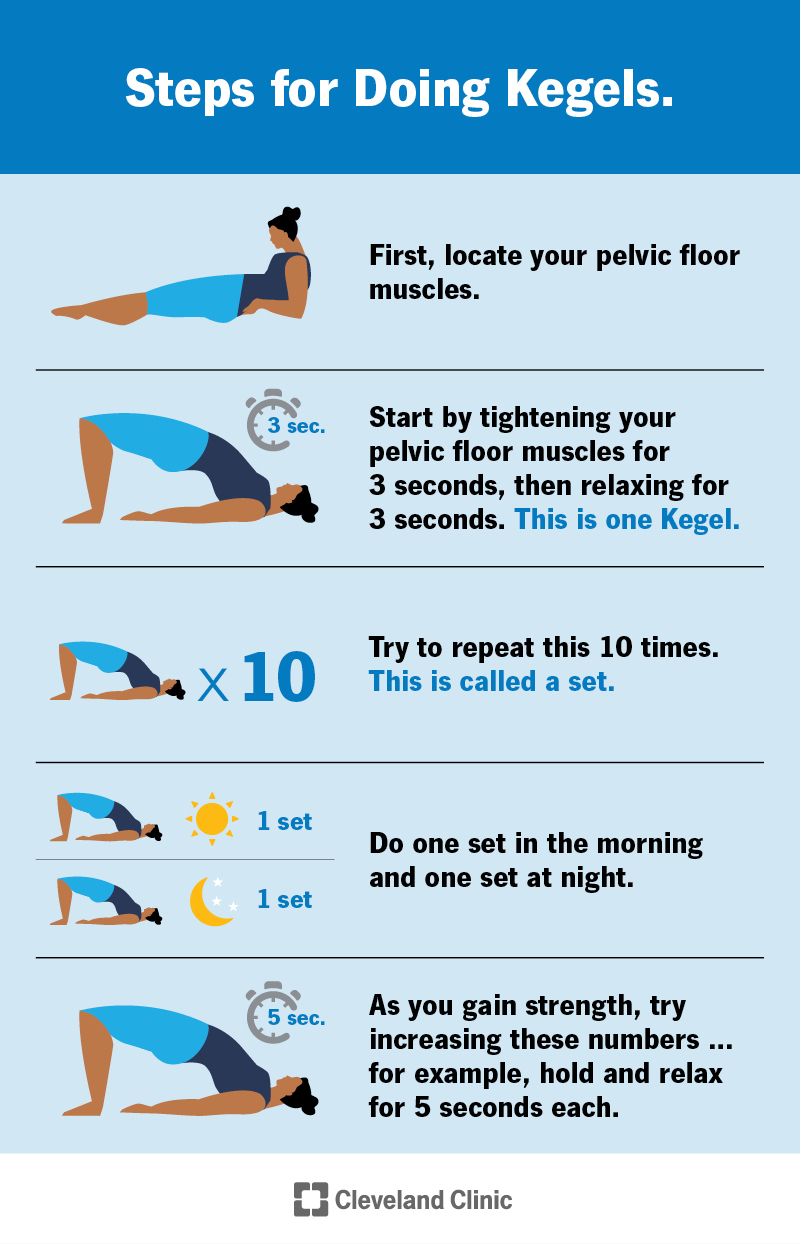
Image Source: my.clevelandclinic.org
The Foundation of Kegel Exercises
Before we discuss timelines, it’s important to grasp what Kegel exercises actually are. Named after Dr. Arnold Kegel, these exercises involve contracting and relaxing the pelvic floor muscles. These are the muscles you use to stop the flow of urine midstream.
What are the Pelvic Floor Muscles?
The pelvic floor is a sling of muscles, ligaments, and tissues that extends from the pubic bone at the front of your pelvis to the tailbone at the back. It supports your pelvic organs, including the bladder, uterus (in women), and rectum.
Why Strengthen Them?
Weak pelvic floor muscles can lead to various issues:
- Urinary Incontinence: The involuntary leakage of urine, often triggered by coughing, sneezing, or laughing.
- Fecal Incontinence: The involuntary leakage of stool or gas.
- Pelvic Organ Prolapse: When pelvic organs drop down from their normal position.
- Sexual Dysfunction: For men, this can include erectile dysfunction and premature ejaculation. For women, it can involve reduced sensation during intercourse.
When Do Kegel Benefits Appear?
The journey to stronger pelvic floor muscles is a marathon, not a sprint. When to expect kegel benefits hinges on several factors, primarily your kegel exercise consistency and the initial strength of your pelvic floor.
Initial Signs of Progress:
- Improved Muscle Awareness: The first thing many people notice is a better sense of their pelvic floor muscles. You might become more aware of contracting and relaxing them intentionally.
- Slightly Better Control: You might start to feel a subtle improvement in holding urine, especially during urges. This can happen within a few weeks of consistent practice.
Measurable Improvements:
- Reduced Leakage: If you experience stress incontinence (leaking when you cough or sneeze), you might notice a decrease in the frequency or amount of leakage. This typically becomes noticeable around the 4-6 week mark.
- Enhanced Sexual Function: Men might observe improved ejaculatory control and harder erections. Women might report increased sensation during intimacy. These changes often become more apparent by 6-8 weeks.
Significant Strength Gains:
- Near Complete Control: For many, achieving significant control over urinary urges and reducing leakage to minimal or non-existent levels takes about 8 to 12 weeks of dedicated effort.
- Long-Term Maintenance: Once you reach your goals, the kegel improvement duration can be maintained through regular, albeit less frequent, exercises.
Factors Influencing Kegel Results Timeline
It’s crucial to acknowledge that everyone’s body is different. Your personal kegel exercise patience will be rewarded, but the exact timeline can vary. Here are the key elements that influence how quickly you see results:
- Consistency: This is arguably the most important factor. Sticking to your kegel exercise routine is paramount. Doing them sporadically will significantly delay your progress.
- Correct Technique: Performing Kegels incorrectly won’t target the right muscles, leading to frustration and no results. It’s essential to ensure you’re engaging the correct muscles.
- Baseline Strength: If your pelvic floor muscles are already quite strong, you might see benefits sooner. Conversely, if they are very weak, it will take longer to build them up.
- Underlying Cause: The reason for your pelvic floor weakness can influence the kegel exercise effectiveness. For instance, weakness due to childbirth might respond differently than weakness from chronic constipation.
- Age and Health: Age can affect muscle tone, and certain health conditions or medications might also play a role.
- Commitment to a Routine: The more diligently you follow your kegel exercise frequency, the faster you’ll likely see results.
Developing an Effective Kegel Exercise Routine
To achieve your desired kegel training progress, a structured approach is essential. Simply knowing how often to do kegels isn’t enough; you need a well-rounded kegel exercise routine.
Identifying the Pelvic Floor Muscles
This is the crucial first step. If you’re unsure if you’re contracting the right muscles, try this:
- Stopping Urine Flow: While urinating, consciously try to stop the flow midstream. The muscles you use to do this are your pelvic floor muscles. Important: Only do this once to identify the muscles; don’t make it a habit as it can interfere with bladder emptying.
- Imagining Holding Gas: Another way is to imagine you are trying to prevent passing gas. The tightening sensation in that area involves your pelvic floor.
The Basics of Kegel Execution
Once you can identify the muscles:
- Contract: Gently tighten your pelvic floor muscles. Imagine you are trying to lift them upwards.
- Hold: Hold the contraction for 3-5 seconds.
- Relax: Completely relax the muscles for the same duration (3-5 seconds).
- Repeat: Aim for 10 repetitions in a set.
How Often to Do Kegels for Optimal Results
The recommended kegel exercise frequency is typically three sets of 10 repetitions per day. This means you’ll be doing about 30 contractions daily. Spreading these sets throughout the day is more effective than trying to do them all at once.
Sample Daily Kegel Exercise Routine:
- Morning: After waking up, do one set of 10 repetitions.
- Midday: During a break at work or a quiet moment, do another set of 10.
- Evening: Before going to bed, complete your third set of 10.
Key Principles for your Kegel Exercise Routine:
- Focus on Quality: It’s better to do 10 perfect Kegels than 20 sloppy ones. Ensure you are fully relaxing between contractions.
- Breathe Normally: Don’t hold your breath. Breathe naturally throughout the exercise.
- Avoid Other Muscles: Make sure you are not contracting your abdominal muscles, buttocks, or thigh muscles. The focus should be solely on the pelvic floor.
Progressing Your Kegel Training
As your pelvic floor muscles get stronger, you can gradually increase the intensity and duration of your holds.
- Increase Hold Time: Gradually increase the hold duration from 5 seconds to 8 seconds, then to 10 seconds. Remember to also increase the relaxation time to match.
- Increase Repetitions: Once 10 repetitions feel easy, you can increase to 15 or even 20 repetitions per set.
- Increase Frequency: If your schedule allows and your muscles are not fatigued, you might consider adding an extra set, but always prioritize proper form and recovery.
Tracking Your Kegel Training Progress
To stay motivated and monitor your kegel training progress, consider keeping a simple log. Note down:
- The date.
- How many sets and repetitions you completed.
- How long you held each contraction.
- Any noticeable changes or improvements (e.g., less leakage, better control).
This will help you see how far you’ve come and adjust your routine as needed.
When to Expect Kegel Benefits: A Deeper Dive
Let’s break down the kegel results timeline in more detail, looking at what you might experience at different stages. Remember that kegel exercise patience is key throughout this process.
Weeks 1-2: Awareness and Initial Activation
- Focus: Learning to correctly identify and contract your pelvic floor muscles.
- What to Expect: You’ll likely become more aware of these muscles. You might feel a slight tightening. Some individuals might notice a very subtle improvement in the strength of their urine stream if they try stopping it.
- Potential Challenges: It’s common to accidentally engage abdominal or gluteal muscles. Conscious effort is needed to isolate the pelvic floor.
Weeks 3-4: Building Endurance
- Focus: Increasing the duration of your holds and ensuring complete relaxation between contractions.
- What to Expect: You should be able to hold contractions for at least 5 seconds with good form. You might start to feel a mild improvement in bladder control, perhaps fewer urgent urges. Kegel exercise consistency during this phase is critical.
- Potential Challenges: Muscle fatigue might set in if you’re trying to do too much too soon.
Weeks 4-8: Developing Strength and Control
- Focus: Increasing the number of repetitions and potentially starting to increase hold times.
- What to Expect: This is often when noticeable benefits start to emerge.
- Urinary Control: You might experience a reduction in leakage during activities like coughing or sneezing.
- Sexual Function: Men may notice improvements in erections or ejaculatory control. Women might report increased sensation.
- Muscle Tone: Your pelvic floor muscles will feel stronger and more responsive.
- This is when many people start to see real kegel results timeline markers.
Weeks 8-12: Significant Improvements and Consolidation
- Focus: Maintaining consistent practice, potentially increasing hold times to 8-10 seconds, and ensuring full relaxation.
- What to Expect:
- Reduced Incontinence: For many, urinary incontinence can be significantly reduced or even eliminated.
- Enhanced Sexual Experience: Sexual function benefits often become more pronounced.
- Greater Pelvic Support: You might feel a general sense of improved pelvic support.
- This phase demonstrates strong kegel exercise effectiveness.
Beyond 12 Weeks: Maintenance and Optimization
- Focus: Integrating Kegels into your lifestyle for long-term maintenance.
- What to Expect: Once you’ve achieved your desired level of strength and control, you don’t need to stop. Continued practice, perhaps fewer sets per day or a couple of times a week, is recommended to maintain the benefits.
- The key here is establishing a sustainable kegel exercise routine that becomes a habit.
Troubleshooting Common Kegel Exercise Issues
Sometimes, despite your best efforts, you might not see results as quickly as you’d hoped. This often stems from common mistakes.
Mistake 1: Not Isolating the Correct Muscles
- Problem: Engaging abdominal muscles, buttocks, or inner thighs instead of the pelvic floor.
- Solution: Revisit the identification steps. Try doing Kegels while lying down with your knees bent, which makes it easier to isolate the pelvic floor. If you’re still struggling, consider seeking guidance from a healthcare professional or a pelvic floor physical therapist.
Mistake 2: Holding Your Breath
- Problem: Holding your breath during contractions can lead to straining and ineffective muscle engagement.
- Solution: Consciously focus on breathing normally throughout each contraction and relaxation phase. Inhale as you prepare, exhale as you contract, and inhale as you relax.
Mistake 3: Not Relaxing Fully Between Contractions
- Problem: Keeping the muscles tense between holds reduces their effectiveness and can lead to fatigue.
- Solution: Ensure you are completely relaxing the pelvic floor muscles for the same duration you held the contraction. It should feel like a complete release.
Mistake 4: Inconsistent Practice
- Problem: Doing Kegels sporadically or forgetting them for days or weeks at a time.
- Solution: Set reminders, link them to existing daily activities (like brushing your teeth), or use a habit-tracking app. Kegel exercise consistency is the cornerstone of success.
Mistake 5: Not Being Patient
- Problem: Expecting immediate results and getting discouraged.
- Solution: Remember that building muscle takes time. Celebrate small victories and trust the process. Kegel exercise patience is a vital component of seeing long-term kegel improvement duration.
Kegel Exercises for Men and Women: Specific Timelines
While the general principles of Kegel exercises apply to both sexes, there can be slight variations in the specific benefits and how quickly they are perceived.
For Women:
- Common Goals: Improving bladder control after childbirth or during menopause, enhancing sexual response.
- Initial Improvements: You might notice a stronger urine stream or less leakage during stress activities within 4-6 weeks.
- More Pronounced Benefits: Enhanced sexual sensation and more significant reduction in incontinence often appear by 8-12 weeks.
- Postpartum Recovery: For women recovering from childbirth, the kegel exercise effectiveness can be closely tied to the healing process. It might take a bit longer to regain muscle strength, often needing a full 12 weeks or more for substantial improvement.
For Men:
- Common Goals: Improving erectile function, reducing premature ejaculation, enhancing bladder control after prostate surgery.
- Initial Improvements: Men might notice a stronger stream or better control over ejaculation within 4-6 weeks.
- More Pronounced Benefits: Sustained erection, delayed ejaculation, and improved bladder control post-surgery are often seen by 8-12 weeks.
- Prostate Surgery: Following prostate surgery, the pelvic floor muscles can be significantly impacted. It’s common for men to experience incontinence for a period. The kegel results timeline in this context can be longer, with significant improvement often seen within 3-6 months of consistent exercise and sometimes with the help of pelvic floor physical therapy.
The Role of Pelvic Floor Physical Therapy
If you’ve been diligently practicing Kegels for several weeks and aren’t seeing the results you expect, or if you’re unsure about your technique, consulting a pelvic floor physical therapist can be incredibly beneficial.
A physical therapist can:
- Assess your pelvic floor muscles: They can use internal examination or biofeedback to accurately assess your muscle strength and identify any issues.
- Provide personalized guidance: They can ensure you are performing Kegels correctly and tailor an kegel exercise routine specific to your needs.
- Address underlying issues: They can help with related problems like muscle overactivity or pain.
- Offer advanced techniques: They might introduce other exercises or modalities to enhance your kegel training progress.
Their expertise can significantly shorten the kegel improvement duration and increase kegel exercise effectiveness.
Frequently Asked Questions (FAQ)
Q1: Can I do too many Kegels?
A1: While not inherently harmful, overdoing Kegels can lead to muscle fatigue and soreness, making them less effective. Stick to the recommended sets and repetitions, focusing on quality over quantity. Listen to your body.
Q2: How long should I continue doing Kegel exercises?
A2: Once you achieve your desired results, continue with a maintenance program of 2-3 sets per week to sustain the benefits. They are a lifelong habit for many.
Q3: I can’t feel my Kegels working. What should I do?
A3: Ensure you’re correctly identifying the muscles using the methods described earlier. If you’re still unsure, consult a healthcare professional or a pelvic floor physical therapist. Incorrect technique is a common reason for not feeling the exercise.
Q4: Are Kegels the only way to strengthen my pelvic floor?
A4: While Kegels are the primary exercise, other activities like Pilates and yoga can also engage and strengthen the pelvic floor muscles. However, direct Kegel contractions are essential for targeted improvement.
Q5: When can I expect to see improvements if I have severe incontinence?
A5: If you have severe incontinence or significant pelvic floor weakness, the kegel results timeline might be longer. It’s crucial to have kegel exercise patience and consider professional guidance from a physical therapist to maximize your kegel exercise effectiveness.
Q6: Does it matter if I do Kegels in different positions?
A6: Initially, it’s best to practice in a lying-down position to isolate the muscles. As you get stronger, you can practice while sitting, standing, or even during daily activities. This enhances the versatility of your kegel training progress.
By understanding the factors that influence the kegel results timeline and committing to a consistent, correct kegel exercise routine, you can effectively strengthen your pelvic floor muscles and enjoy the numerous health benefits they provide. Remember, kegel exercise patience and dedication are your greatest allies in this journey.